
Jack Yerka-Surreal Artist Beyond Imagination
Jacek Yerka is a Polish surreal artist who is recognised for his spatial creativity found in his paintings. Yerka’s artworks emphasise the heavy balance between ‘industrial’ and the ‘pastoral’ through his renowned quality in transforming ordinary-recognisable objects into unique surrealistic spaces. However, the previously untransformed reality is still embedded within his work and in doing so the artist never fails to convey his mood and commentary about the real world. The complexities of his uniquely evocative dream like spaces are painted on canvases. The audience is challenged to view objects from many diverse perspectives. Not only he is talented in reorganising the physical world, he also seeks to rearrange the viewer’s perception of the relationship between objects, ground and sky, land and sea, animate and inanimate and causing the sublime shift from ordinary to new (Line and Colours).
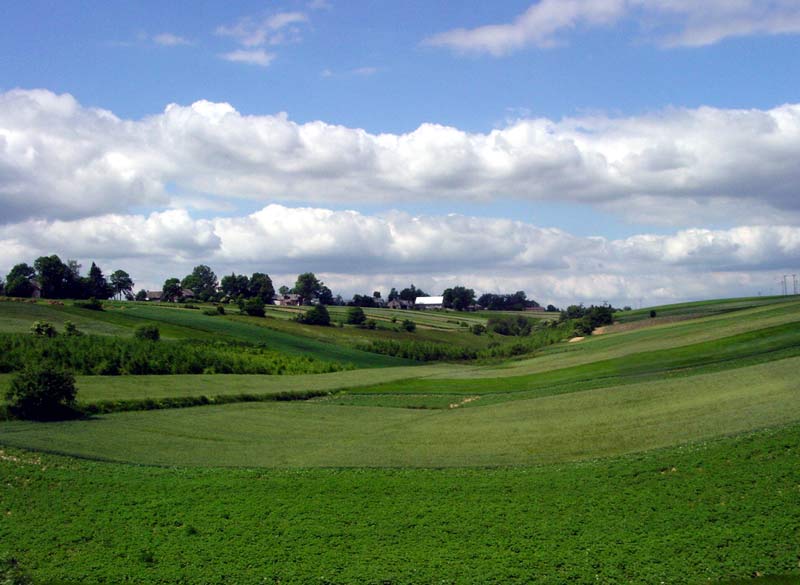
Yerka works with both acrylic and oil on canvas, pastel drawings and pencil or ink drawing. He develops the ideas in his head first and using a soft 2B pencil, he sketches in a notebook. “If the idea is worth to be developed, it is then coloured with crayons, some new details are added and then again on a good quality paper with full colours” (Yerka, 2006). The pastoral atmosphere of the Polish countryside provides a solid and mimetic foundation of Yerka’s work. His paintings are deeply influenced by his childhood; the surroundings of his home in the 1950’s and in particular, his grandmother’s kitchen where he regularly spent his leisure time. Jack Yerka: “For me, the 1950’s were a kind of Golden Age. These were the happy years of my childhood, filled with wonder at the world around me…” (Top Design Magazine). Rather than pushing and forcefully inserting its delirium into the viewer’s conscious space, Yerka’s regeneration of the existing reality into fantasy invites the audience to be absorbed into his work.
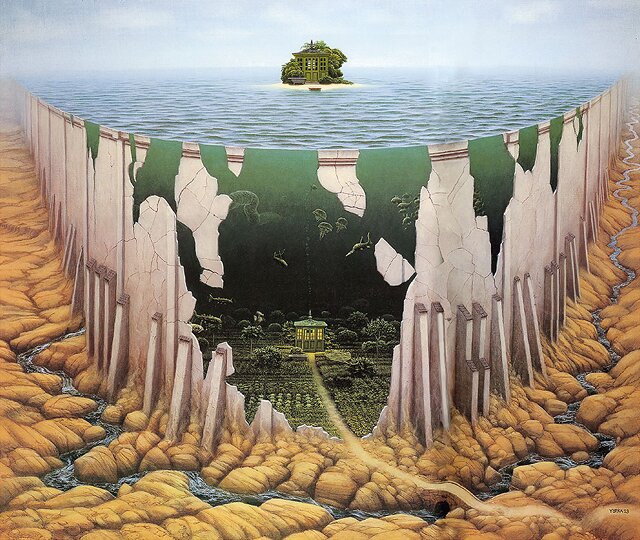
The exhibition contains various bodies of work including the painting, ‘Double Life’ (2005), ‘Double Life II'(2006) and ‘Tower of Subconsciousness' (2008). ‘Double Life' (2005) is an artwork which perfectly portrays the title of the work; two perspectives of life. Based on precise painting techniques, taking pattern from former masters like Jan van Eyck or Hieronymus Bosch; he has created a surrealistic composition containing sky, sea and land (Yerka, 2006). The house above the sea level represents the external life and the underwater house represents the subconscious of life. The theme of 'living fantasy' is embedded within the work as ordinary architectures and the nature are combined to create a surrealistic space. The artwork blends the horizon of the background and foreground, creating an illusion of one landscape. The difference of above and under water is well expressed through the colours and the level of light. The two identical houses in two diverse landscapes unite the painting. The focal point is the house above the sea level as the dark colours stand out amongst the light and soft pastel colours. The focal point then brings the viewer’s attention to the water and finally down to the underwater house. Yerka has expressed a hidden subconsciousness of one’s life often not revealed to the public. He has presented that a sense living does exist inside a desolated land. The audience is invited to see architectural structures emerging out from the natural environment. Like the process of alchemy, Yerka has combined architecture, land and sea to produce a new, familiar but fantasised landscape.
Diana Al-Hadid- Emerging Impossible Architectural Artist
Between construction and deconstruction, the sculptures of Diana Al-Hadid including an overturned building and collapsed structures reveal the fragility of all human undertakings, endangered by their own excesses (Nadour). Diana Al-Hadid is a Syrian-American artist who works with various medium of artworks but in particular, sculptures. Her sculptures take ‘towers’ as their central theme, drawing together a wide variety of associations: power, wealth, technological and urban development, along with ideas of progress and globalism (The Saatchi Gallery). Her works are usually made out of materials such as plaster, Styrofoam, wax, cardboard and other natural materials. Al-Hadid’s sculptures positions the viewers to take on a fictional role as futuristic observer who mourns the tragic follies of a past civilisation. Her geometric forms attempt to bridge the void between the mystical and scientific understandings of the world. Al-Hadid suggests, “The identity of a place and its people is reciprocal: places identify a people as much as people identify a place” (Al-Hadid, 2011). Her works are highly influenced by a mixture of Arab tales with mythological epics and biblical writhing, Islamic art along with classical painting Baroque, Gothic and Romanesque architectures which are also mixed with medieval churches and the symbols and motifs from physics and astronomy (Savage, 2010).
In the body of works of 'towers', Al-Hadid herself has described ‘All the stops’ (2007), as “impossible architecture” (The Saatchi Gallery). It is a sculpture made out of cardboard, wood, metal, plastic and paint which envision a palatial structure, utilising stylistic elements from medieval churches and futuristic stadiums. Musical references are found throughout the piece as broken columns are made from plastic recorders and tiers are shingled with tiny piano keys. The sculpture is very technically precise in its presentation. The natural colours of the materials well provide a unifying element in the body of work. The artist suggests to the audience how harmony and beauty may arise from ruin and confusion. The work portrays an evasive quality of sound, where each level of the tower contributes to a sense of harmonic rhythm. The tower itself however, is presented as a ruin, empty and desolate. Working within the socio-cultural context, Al-Hadid invites the audience to see various perspectives of architecture as the Director of Sculpture Center, Jeremy Strick stated: “Diana Al-Hadid creates breathtaking sculptures that surprise us by their unusual forms, unconventional use of materials, and distinctive range of reference and allusion. Her innovative work opens up new ground for the form and meaning of sculpture” (Nasher Sculpture Center).
Emergence is a theme presented by both artists in two different ways. In Diana Al-Hadid's works, the viewers are able to see the emergence of architectural structure from confusion. Similarly to Al-Hadid, Jacek Yerka has architectural form emerging from within natural objects. The emergence of form from formless contexts unites both of these artists in their expressions.
Bibliography:
Al-Hadid. D (2011) Priska C. Juschka Fine Art, http://www.priskajuschkafineart.com/artists/Diana_Al_Hadid/statement.php (03.09.11)
Define Industrial, http://dictionary.reference.com/browse/industrial (03.09.11)
Define Pastoral, http://dictionary.reference.com/browse/pastoral (03.09.11)
Nadour, http://nadour.org/artists/diana-al-hadid/ (03.09.11)
Define Pastoral, http://dictionary.reference.com/browse/pastoral (03.09.11)
Nadour, http://nadour.org/artists/diana-al-hadid/ (03.09.11)
Lines and Colours, http://www.blogger.com/goog_1395920133 (15.08.11)
Hieronymus Bosch-Olga's Gallery, http://www.abcgallery.com/B/bosch/bosch.html (03.09.11)
Jan van Eyck, http://en.wikipedia.org/wiki/Jan_van_Eyck (03.09.11)
Karbar. D,(2005) Polish Countryside, http://karber.org/favoritephotos/polish-countrysideweb.jpg (03.09.11)
Medieval Church Architecture, http://www.historylearningsite.co.uk/medieval_church_architecture.htm (03.09.11)
Nasher Sculpture Center, http://www.nashersculpturecenter.org/About-NSC/Press/NASHER-SCULPTURE-CENTER-PRESENTS-SIGHTINGS--DIANA- (07.09.11)
Payne. J, (2009) Tales from Arabic, http://www.wollamshram.ca/1001/Payne/tfta/tfta.htm (03.09.11)
Savage. L (2010) Diana Al-Hadid: First Solo Exhibition, http://encoremag.com/los-angeles/articles/952/diana-al-hadid-solo-exhibit (03.09.11)
Jan van Eyck, http://en.wikipedia.org/wiki/Jan_van_Eyck (03.09.11)
Karbar. D,(2005) Polish Countryside, http://karber.org/favoritephotos/polish-countrysideweb.jpg (03.09.11)
Medieval Church Architecture, http://www.historylearningsite.co.uk/medieval_church_architecture.htm (03.09.11)
Nasher Sculpture Center, http://www.nashersculpturecenter.org/About-NSC/Press/NASHER-SCULPTURE-CENTER-PRESENTS-SIGHTINGS--DIANA- (07.09.11)
Payne. J, (2009) Tales from Arabic, http://www.wollamshram.ca/1001/Payne/tfta/tfta.htm (03.09.11)
Savage. L (2010) Diana Al-Hadid: First Solo Exhibition, http://encoremag.com/los-angeles/articles/952/diana-al-hadid-solo-exhibit (03.09.11)
Siddiqui E, (2008) Islamic Art, http://www.colostate.edu/orgs/MSA/find_more/islart.html (03.09.11)
The Saatchi Gallery, http://www.saatchi-gallery.co.uk/artists/diana_hadid.htm?section_name=unveiled (03.09.11)
The Saatchi Gallery, http://www.saatchi-gallery.co.uk/artists/diana_hadid.htm?section_name=unveiled (03.09.11)
Top Design Magazine,
http://www.topdesignmag.com/jacek-yerka-an-incredible-surrealist-painter/ (15.08.11)
http://www.topdesignmag.com/jacek-yerka-an-incredible-surrealist-painter/ (15.08.11)
What's the difference?-Romanesque vs. Gothic Architecture, http://www.mentalfloss.com/difference/romanesque-vs-gothic-architecture/ (03.09.11)
Yerka. J, (2006) Jacek Yerka painter of the fantasy worlds, http://www.yerkaland.com/project.php (15.08.11)



No comments:
Post a Comment